
Side by side
Deep TMS vs standard TMS, point by point
Most of the differences are in the coil, the session length and the seizure reports, not in proven results.
| Point | Deep TMS (H-coil) | Standard TMS (figure-8 coil) |
|---|---|---|
| Coil | H-coil with an air core, fitted on the head in a helmet-like device (BrainsWay's H1 coil for depression). | Figure-8 coil with a ferromagnetic core, placed against the head (NeuroStar, the first cleared system, in 2008). |
| Depth and spread | Reaches somewhat deeper, but spreads over a much larger area. | Shallower and focused on a small spot. |
| Cleared depression protocol | 18 pulses a second, 1,980 pulses, 20.2 minutes, 5 days a week for 4 weeks, then optional twice-weekly sessions for 12 weeks. | 10 pulses a second, 3,000 pulses, 37.5 minutes, 5 days a week for 6 weeks. |
| Shorter options | An accelerated theta burst protocol, cleared September 2025 (sessions under 10 minutes, several a day). | Theta burst, about 3 minutes a session in the THREE-D trial; FDA cleared a theta burst system for depression in 2018. |
| Pivotal trial against sham | Response 38.4% vs 21.4%, remission 32.6% vs 14.6% at week 5 (per-protocol group). | 301 patients; response higher at weeks 4 and 6; remission about twice sham at week 6. |
| Head-to-head trial (Filipčić 2019) | Remission 60%; response significantly better than figure-8. | Remission 43%; the remission difference was not statistically significant. |
| Seizures in a 2018 clinician survey | 5.56 per 1,000 patients. | 0.14 per 1,000 patients (three most-used figure-8 devices combined). |
| Billing codes in Aetna's policy | Same CPT codes, 90867 to 90869. | Same CPT codes, 90867 to 90869. |
Sources: FDA's own comparison table in the K122288 summary (protocols), the Levkovitz, O'Reardon and Filipčić trials, the Deng simulation study, the Taylor survey, the THREE-D trial, FDA records K173620 and K251449, and Aetna CPB 0469. Each is discussed below. The two pivotal trials used different patients and scales, so their numbers are not directly comparable.
The physics
What “deep” actually means
No coil can be both deep and focused. Going deeper always means stimulating a wider area.
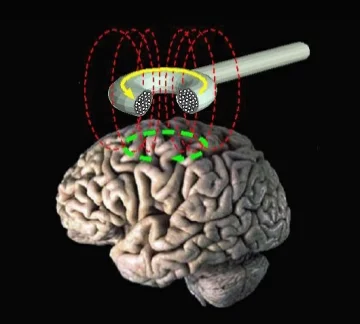

A 2013 study in Brain Stimulation simulated the electric field of 50 TMS coils in a model head. Every coil followed the same rule: “coils with larger half-value depth cannot be as focal as more superficial coils.” The H-coils reached a half-value depth of 1.7 to 2.4 cm. Against a standard 70 mm figure-8 coil, that is 22 to 72 percent deeper, “at the expense of” a spread 406 to 811 percent wider. The authors wrote that their results may help interpret studies that claim no significant depth advantage of an H-coil over a 70 mm figure-8 coil.
- Figure-8 coil. A small, focused field near the surface of the brain. For depression it is placed over the left prefrontal cortex, an area NIMH describes as thought to be involved in mood regulation.
- H-coil.A broader field. FDA's 2013 summary describes a coil design “enabling activation of deep brain regions.”
- What neither does. Neither is deep brain stimulation, which NIMH describes as a surgical procedure. NIMH calls TMS noninvasive.
Source: Deng, Lisanby and Peterchev, Brain Stimulation, 2013; FDA K122288; NIMH.
The evidence
Does deep TMS work better than standard TMS?
Both work better than sham. The randomized head-to-head trial reviewed here gave a mixed answer.
A head-to-head trial
In an industry-independent trial in Croatia, 228 adults with major depression were randomly assigned to 20 sessions with the H1 coil, 20 sessions with a figure-8 coil, or medication alone. Everyone stayed on medication.
- Remission at week 4: 60 percent with the H1 coil, 43 percent with the figure-8 coil, 11 percent with medication alone.
- The remission difference between the two coils was not statistically significant (odds ratio 1.74, 95% confidence interval 0.79 to 3.83).
- Response was significantly better with the H1 coil (odds ratio 2.33), and depression scores fell 59 percent against 41 percent.
- Safety, tolerability and quality-of-life changes were comparable.
- Limits: one center, single-blind, no sham coil, and the medication-only group was seen less often.
Source: Filipčić and colleagues, Journal of Psychiatric Research, 2019.
Each coil against sham
- Deep TMS. In the multicenter trial behind the 2013 clearance, adults who had not improved on one to four antidepressants had 20 sessions over four weeks. Response was 38.4 percent against 21.4 percent with sham, and remission 32.6 percent against 14.6 percent, at week 5 in the per-protocol group.
- Standard TMS. In the pivotal NeuroStar trial, 301 medication-free patients had 3,000 pulses a session for four to six weeks. Response was significantly higher than sham at weeks 4 and 6, and remission was about twice as high at week 6. The dropout rate for side effects was 4.5 percent.
What a network meta-analysis found
A 2019 BMJ analysis pooled 113 trials with 6,750 patients. In its network analysis, high-frequency left-sided rTMS had an odds ratio for response of 3.17 against sham. On deep TMS the authors wrote:
“For deep transcranial magnetic stimulation we found evidence of antidepressant efficacy across outcome measures in pairwise analyses but not in network meta-analysis. As the direct evidence is based on data from only two randomised controlled trials, further investigations are warranted.”
Mutz and colleagues, BMJ, 2019
The practical reading: both coils have real evidence, the deep TMS evidence base is smaller, and no trial has shown that one coil should be chosen over the other for everyone.
Safety
Side effects and seizure risk
Scalp discomfort and headache are common with both. Seizures are rare with both, and one survey found them more often with the H-coil.
Side effects in the trials
- Deep TMS trial (FDA summary). Application site pain 25.0 percent against 0.8 percent on sham, application site discomfort 19.4 percent against 4.1 percent, jaw pain 10.2 percent against 0.8 percent, headache 47.2 percent against 36.4 percent.
- Standard TMS trial. Side effects were generally mild and limited to transient scalp discomfort or pain.
- Theta burst vs standard 10 Hz sessions (THREE-D). Headache was the most common treatment-related side effect in both groups: 64 percent with 10 Hz and 65 percent with theta burst. Pain was rated 3.8 out of 10 with theta burst and 3.4 with 10 Hz.
Seizures: two counts, two kinds of source
- A clinician survey. In 2018, 134 members of the Clinical TMS Society reported 18 seizures in 586,656 sessions and 25,526 patients: 0.31 per 10,000 sessions overall. The BrainsWay H-coil rate was 5.56 per 1,000 patients against 0.14 per 1,000 for the three most-used figure-8 devices combined, a significant difference. The authors call the absolute risk low and say well-designed prospective studies are warranted.
- The manufacturer's own count.BrainsWay's chief medical officer and colleagues, in a BrainsWay-funded report, listed 55 H-coil seizures reported from 2010 to October 2020 among an estimated 94,857 patients: 6 per 10,000 patients, or 2 per 10,000 when the instructions for use were followed. Possible causes they name: not rechecking the motor threshold once a week, medication changes, substance use in the 24 hours before, and poor sleep the night before.
The two numbers come from different methods, a clinician survey and a manufacturer count that estimates patients from head caps sold, so they do not settle the question. Our TMS side effects guide covers who needs extra screening.
Sources: FDA K122288, O'Reardon 2007, THREE-D 2018, Taylor 2021, Tendler 2021.
FDA records
What each device is FDA-cleared for
Each record below is a 510(k) clearance or a De Novo grant for a named device and use. FDA did not “approve” these devices the way it approves drugs.
| Year and device | Cleared use | FDA record |
|---|---|---|
| 2008: NeuroStar (figure-8) | Adults with major depression after an antidepressant did not help | DEN070003 |
| 2013: BrainsWay Deep TMS (H-coil) | Adults with major depression after antidepressants did not help | K122288 |
| 2018: BrainsWay Deep TMS | Obsessive-compulsive disorder (De Novo: FDA created a new device type for OCD) | DEN170078 |
| 2018: MagVenture MagVita (Cool-B70 coil) | Major depression with theta burst stimulation | K173620 |
| 2020: MagVenture (Cool D-B80 coil) | OCD, as an add-on treatment in adults | K193006 |
| 2020: BrainsWay Deep TMS | Short-term smoking cessation | K200957 |
| 2021: BrainsWay Deep TMS | Anxiety symptoms in adults with major depression | K210201 |
| 2022: NeuroStar | Anxiety symptoms in adults with major depression | K220127 |
| 2024: NeuroStar | Add-on treatment of major depression at ages 15 to 21 | K231926 |
| 2024: BrainsWay Deep TMS | Labeling extended to adults aged 22 to 86 | K222196 |
| 2025: BrainsWay Deep TMS | Accelerated theta burst protocol for major depression | K251449 |
- Some pages say deep TMS is the only TMS cleared for OCD. That has not been true since August 9, 2020, when FDA cleared MagVenture's system with its Cool D-B80 coil as an add-on treatment for adults with OCD.
- Age matters: NeuroStar is cleared as an add-on for ages 15 to 21, and BrainsWay's labeling covers adults aged 22 to 86. Ask whether the device a clinic uses is cleared for your age and condition.
For PTSD and anxiety, which are different questions, read our guides on TMS for anxiety and TMS for PTSD.
Your calendar
Session length and schedule


The coil sets the session length less than the protocol does.
- Original cleared protocols. 20.2 minutes for deep TMS, 37.5 minutes for the figure-8 protocol, five days a week (FDA K122288).
- Theta burst (THREE-D trial). About 3 minutes a session. In the THREE-D trial of 414 adults, it was non-inferior to 37.5-minute sessions: depression scores fell from 23.6 to 13.4 with theta burst and from 23.5 to 13.4 with standard sessions.
- BrainsWay's accelerated protocol. Five sessions a day on 6 days over 14 days, then two sessions a day once a week for 4 weeks, each under 10 minutes. In the trial behind the 2025 clearance (104 patients enrolled), response was 87.8 percent against 87.5 percent with the standard deep TMS schedule, and remission 78.0 percent against 87.5 percent. Headaches were reported by 41.2 percent against 15.1 percent.
- How insurers see it. Aetna lists accelerated TMS, including SAINT, as experimental, investigational or unproven, so a faster schedule may not be covered.
Labyrinth Psychiatry Group, which this site refers to, lists a standard course of 36 sessions for depression, five days a week, about six to eight weeks, with sessions of 19 to 45 minutes depending on the diagnosis. Compare accelerated SAINT TMS costs in our SAINT cost guide.
Sources: FDA K122288, THREE-D, FDA K251449, BrainsWay release, Aetna CPB 0469, Labyrinth TMS page.
Insurance
Cost and insurance: what one insurer's policy says about the coil
In Aetna's policy, the rules turn on your diagnosis and treatment history, not on the coil.
Aetna's policy (CPB 0469, last reviewed July 17, 2026) considers TMS medically necessary when all of its criteria are met, including:
- It is given by an FDA-cleared device, which the policy says includes intermittent theta burst, used for its FDA-labeled indication.
- The member is 15 or older, with severe major depression confirmed by a psychiatrist and measured on a standard rating scale.
- For adults: an inadequate response to two antidepressants from different classes, each at the maximally tolerated labeled dose for at least 8 weeks, and to augmentation therapy for at least 8 weeks, in the current episode within the past 5 years.
- A course of up to 30 sessions plus 6 tapering sessions.
The policy lists three CPT codes for TMS, 90867, 90868 and 90869, and none of them names a coil. For prices and Medicare amounts, read our TMS cost and insurance guide.
Source: Aetna CPB 0469, read November 5, 2026. Other plans set their own rules; ask yours in writing.
After a course that did not help
If standard TMS did not help, should you try deep TMS?
Aetna's policy says the evidence for switching devices after a TMS course did not work is lacking.
“There is a lack of evidence that persons who fail to respond or become refractory to one brand of TMS device will respond to another brand of TMS, theta burst stimulation (TBS), or deep TMS (dTMS) device.”
Aetna CPB 0469, last reviewed July 17, 2026
- A psychiatrist can review the diagnosis and everything tried so far before planning the next step.
- Other options for depression that has not lifted include SPRAVATO and ECT. See treatment-resistant depression.
Printable
Questions to ask a TMS clinic about its coil
Ask the same questions whichever coil a clinic uses. Keep health details for the visit, not for a web form.


- Which device and coil do you use, and which FDA clearance covers my age and condition?
- Which protocol: standard sessions, theta burst, or an accelerated schedule?
- How long is each session, how many sessions are planned, and over how many weeks?
- How do you measure progress, and when would you stop or change the plan?
- How often do you recheck my motor threshold, and what should I tell you before each session?
- What will my plan require before approval, and what will I pay per session?
- If I had TMS before and it did not help, why would this course be different?
- Who do I call if I feel worse during the course?
Common questions
Deep TMS vs TMS: questions people ask
What is the difference between deep TMS and regular TMS?
The coil. Regular TMS uses a figure-8 coil that stimulates a small, shallow spot. Deep TMS uses BrainsWay's H-coil, fitted in a helmet-like device, which reaches somewhat deeper but spreads over a much larger area. In FDA's comparison of the first cleared protocols, a deep TMS session was 20.2 minutes and a figure-8 session 37.5 minutes, five days a week either way.
Is deep TMS better than regular TMS?
Not proven. An industry-independent head-to-head trial of 228 patients in Croatia found remission in 60 percent with the H1 coil and 43 percent with the figure-8 coil, a difference that was not statistically significant, while response was significantly better with the H1 coil. A 2019 BMJ network meta-analysis found evidence for deep TMS in direct comparisons but not in the network analysis, from only two randomized trials.
What does dTMS stand for?
Deep transcranial magnetic stimulation. It is a form of repetitive TMS that uses an H-coil instead of a figure-8 coil. It is not deep brain stimulation, which NIMH describes as a surgical procedure.
Is deep TMS safe?
The absolute seizure risk is low with both coils. In a survey of Clinical TMS Society members covering 586,656 sessions, the H-coil rate was 5.56 seizures per 1,000 patients against 0.14 for the three most-used figure-8 devices combined. BrainsWay's own authors reported 6 per 10,000 patients overall and 2 per 10,000 when the instructions for use were followed. Ask the clinic how it screens for seizure risk.
How painful is TMS therapy?
NIMH says patients usually feel a slight knocking or tapping on the head. In the deep TMS trial behind FDA clearance, application site pain was reported by 25.0 percent of patients against 0.8 percent on sham, and headache by 47.2 percent against 36.4 percent. In the THREE-D trial of standard 10 Hz and theta burst sessions, headache was the most common side effect in both groups, 64 and 65 percent.
Does insurance cover deep TMS?
In Aetna's policy, the one read for this page, the rules turn on your diagnosis and treatment history, not on the coil. It covers TMS from an FDA-cleared device used for its labeled indication when its criteria are met, under CPT codes 90867 to 90869, none of which names a coil. Aetna lists accelerated TMS as experimental. Check your own plan in writing.
If regular TMS did not work, will deep TMS?
Nobody can promise that. Aetna's policy says there is a lack of evidence that people who fail to respond to one brand of TMS device will respond to another brand, theta burst stimulation or deep TMS. A psychiatrist can review the diagnosis and everything tried so far.
How long is a deep TMS session compared with standard TMS?
In FDA's comparison of the first cleared protocols: 20.2 minutes for deep TMS, 37.5 minutes for the original figure-8 protocol. Theta burst sessions in the THREE-D trial took about 3 minutes, and BrainsWay's accelerated protocol uses sessions under 10 minutes, several a day. Ask the clinic which protocol it plans to use.
Sources
What this page is built on
- US Food and Drug Administration. 510(k) summary K122288: Brainsway Deep TMS System, major depressive disorder (decision January 7, 2013), including FDA's comparison table against the NeuroStar TMS Therapy System and the trial's side-effect table.
- Filipčić I, Šimunović Filipčić I, Milovac Ž, and colleagues. Efficacy of repetitive transcranial magnetic stimulation using a figure-8-coil or an H1-Coil in treatment of major depressive disorder; a randomized clinical trial. Journal of Psychiatric Research. 2019;114:113-119.
- Levkovitz Y, Isserles M, Padberg F, and colleagues. Efficacy and safety of deep transcranial magnetic stimulation for major depression: a prospective multicenter randomized controlled trial. World Psychiatry. 2015;14(1):64-73.
- O'Reardon JP, Solvason HB, Janicak PG, and colleagues. Efficacy and safety of transcranial magnetic stimulation in the acute treatment of major depression: a multisite randomized controlled trial. Biological Psychiatry. 2007;62(11):1208-1216.
- Mutz J, Vipulananthan V, Carter B, and colleagues. Comparative efficacy and acceptability of non-surgical brain stimulation for the acute treatment of major depressive episodes in adults: systematic review and network meta-analysis. BMJ. 2019;364:l1079.
- Blumberger DM, Vila-Rodriguez F, Thorpe KE, and colleagues. Effectiveness of theta burst versus high-frequency repetitive transcranial magnetic stimulation in patients with depression (THREE-D): a randomised non-inferiority trial. Lancet. 2018;391(10131):1683-1692.
- Taylor JJ, Newberger NG, Stern AP, and colleagues. Seizure risk with repetitive TMS: survey results from over a half-million treatment sessions. Brain Stimulation. 2021;14(4):965-973.
- Tendler A, Harmelech T, Gersner R, Roth Y. Seizures provoked by H-coils from 2010 to 2020. Brain Stimulation. 2021;14(1):66-68 (funded by BrainsWay; all four authors list BrainsWay Ltd. as an affiliation).
- National Institute of Mental Health. Brain Stimulation Therapies (last reviewed March 2024).
- Deng ZD, Lisanby SH, Peterchev AV. Electric field depth-focality tradeoff in transcranial magnetic stimulation: simulation comparison of 50 coil designs. Brain Stimulation. 2013;6(1):1-13.
- US Food and Drug Administration. 510(k) summary K251449: BrainsWay Deep TMS System, accelerated iTBS protocol for major depressive disorder (decision September 13, 2025).
- BrainsWay. BrainsWay receives FDA clearance for accelerated Deep TMS protocol (news release, September 16, 2025).
- BrainsWay. What is Deep TMS (the manufacturer's own explainer, used here only for how the device is fitted).
- Aetna Clinical Policy Bulletin 0469: Transcranial Magnetic Stimulation and Cranial Electrical Stimulation (last review July 17, 2026).
- Labyrinth Psychiatry Group: TMS therapy in Cranford, NJ (read November 5, 2026)
Every source was read November 5, 2026. Trial numbers are group results and do not predict any one person's outcome. This page does not recommend one coil over the other, or a device or treatment for a particular person.